






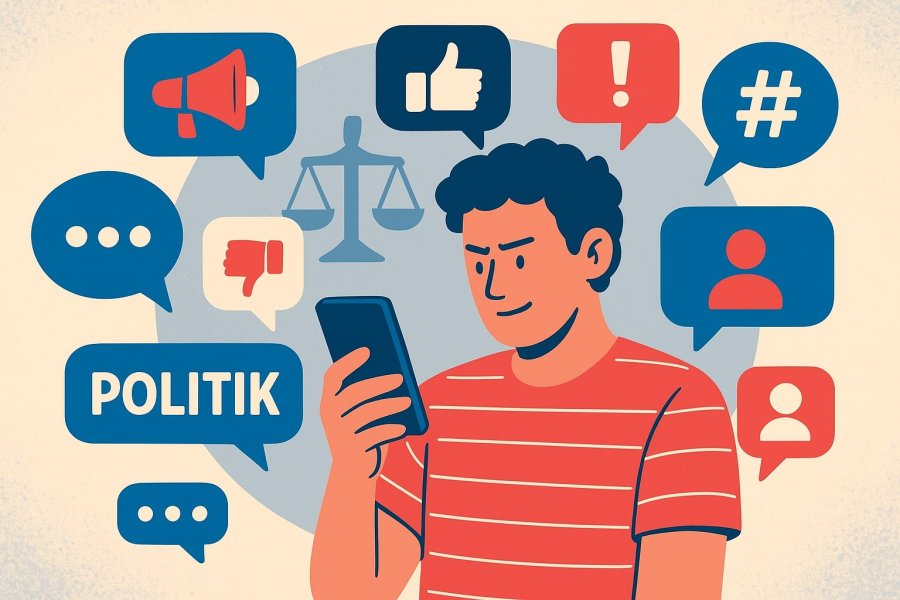
Buzzer Politik: Understanding Political Online Influencers in Indonesia
Jakarta, turkeconom.com – In Indonesia’s digital public sphere, political conversation no longer happens only through television debates, newspaper editorials, or formal party messaging. Much of it now unfolds on social media, where narratives move quickly, audiences react instantly, and public opinion can be shaped by accounts with large reach or coordinated influence. This is the environment in which Buzzer Politik has become an important and often controversial concept. The term is widely used to describe online actors who amplify political messages, defend certain interests, influence public perception, or drive discussion around political events and figures.
What makes Buzzer Politik especially significant is that it sits at the intersection of communication, power, technology, and public trust. Some see political buzzers as a modern extension of campaign communication and digital advocacy. Others associate them with manipulation, coordinated propaganda, disinformation, or paid influence. Because the term is used broadly and sometimes loosely, understanding Buzzer Politik requires a more careful look at how political messaging works online in Indonesia, who participates in it, and why it matters for democracy and media literacy.
What Buzzer Politik Means

Buzzer Politik generally refers to individuals, groups, or online networks that actively amplify political narratives on digital platforms. These actors may support politicians, parties, public figures, causes, or policy positions by spreading messages, defending reputations, attacking opponents, or shaping trending discussions.
A Buzzer Politik ecosystem may involve:
- Influential social media accounts with political alignment
- Anonymous or pseudonymous accounts amplifying narratives
- Coordinated posting or hashtag campaigns
- Paid digital promotion linked to political interests
- Organic supporters who voluntarily defend a cause or candidate
- Content framed to persuade, provoke, or dominate online attention
Because of this range, Buzzer Politik is not always a single type of actor. It can refer to formal campaign-linked communication teams, semi-organized supporter networks, freelance digital operators, or loosely aligned online communities.
Why Buzzer Politik Matters
The rise of Buzzer Politik matters because digital platforms have become central to how political information is created, circulated, and contested in Indonesia. Online narratives can influence how people interpret events, evaluate leaders, and respond to public controversy.
Shaping Public Opinion
Political buzzers can help frame issues in ways that favor certain interests or interpretations.
Amplifying Narratives
Buzzer Politik networks can increase the visibility of messages through repetition and coordinated timing.
Influencing Media Agendas
Online momentum sometimes affects what journalists, commentators, and public figures choose to discuss.
Mobilizing Supporters
Digital influencers and campaign amplifiers can energize supporters and direct participation.
Complicating Trust
The presence of coordinated messaging can make it harder for users to distinguish authentic opinion from engineered influence.
These effects make Buzzer Politik relevant not only during elections, but also in everyday governance, public controversy, and issue-based advocacy.
Core Characteristics of Buzzer Politik
To understand Buzzer Politik more clearly, it helps to identify some recurring features often associated with this phenomenon.
| Characteristic | Role in Buzzer Politik | Why It Matters |
|---|---|---|
| Message Amplification | Repeats or boosts a political narrative | Increases visibility and reach |
| Network Coordination | Synchronizes posts, hashtags, or themes | Creates momentum and apparent consensus |
| Audience Targeting | Tailors content to specific groups | Improves persuasion and engagement |
| Narrative Framing | Defines how events or figures are interpreted | Shapes public perception |
| Platform Adaptation | Uses style suited to each social medium | Expands influence across audiences |
These characteristics do not always appear together, but they help explain why Buzzer Politik can be effective in fast-moving digital environments.
Types of Political Online Influencers
Not every politically active account functions in the same way. The label Buzzer Politik is often used broadly, but the actors behind it may differ significantly.
Official Campaign Communicators
These are formal teams or affiliated figures promoting candidates or parties through structured messaging.
Partisan Influencers
Some accounts operate like political commentators or opinion leaders with clear ideological leanings.
Anonymous Amplifier Accounts
These accounts may focus less on original analysis and more on spreading messages, slogans, clips, or attacks.
Volunteer Supporters
Not all amplification is paid or coordinated. Some political participation is genuinely organic and driven by belief.
Networked Operators
In some cases, Buzzer Politik refers to actors working within organized ecosystems that coordinate timing, hashtags, and messaging goals.
This distinction matters because public debate often collapses all digital political activity into one category, even though motivations and methods can vary widely.
Risks and Controversies Around Buzzer Politik
The concept of Buzzer Politik is controversial because it raises concerns about the health of public discourse and democratic communication.
Disinformation and Misinformation
Some political buzzers may spread misleading or false content to attack opponents or influence opinion.
Artificial Consensus
Coordinated amplification can create the impression that a view is more popular than it really is.
Harassment and Polarization
Buzzer Politik activity may contribute to online hostility, intimidation, or deepening political division.
Reduced Transparency
Audiences may not know whether content is sponsored, coordinated, or genuinely spontaneous.
Erosion of Trust
As users become more suspicious of online narratives, trust in public communication can weaken overall.
These concerns are especially important in contexts where social media already plays a strong role in shaping news consumption and civic perception.
Why Media Literacy Is Essential
Understanding Buzzer Politik is not just about identifying political actors online. It is also about building stronger media literacy so users can evaluate content more carefully.
This means paying attention to:
- Whether multiple accounts are repeating the same framing at the same time
- Whether a claim is supported by credible reporting or evidence
- Whether emotionally charged content is designed mainly to provoke reaction
- Whether an account consistently pushes one-sided narratives without transparency
- Whether engagement appears organic or unusually coordinated
In practical terms, media literacy helps people respond to Buzzer Politik with analysis rather than impulse. That is a useful skill in any democracy, and especially in online spaces where velocity often outruns verification.
Final Thoughts
Buzzer Politik reflects the changing nature of political communication in Indonesia, where online platforms have become major arenas for influence, persuasion, mobilization, and contestation. The term can refer to a wide range of actors, from formal campaign communicators to anonymous amplifier networks, and its impact reaches far beyond election cycles.
The key takeaway is simple: Buzzer Politik matters because it shapes how political narratives circulate and how citizens interpret public life online. Understanding it requires attention not only to who is speaking, but also to how messages are amplified, framed, and received in Indonesia’s evolving digital landscape.
Explore our “Politic” category for more insightful content!
Don't forget to check out our previous article: Coalition Politics: Building Alliances and Power-Sharing in Indonesia’s Multiparty System
